


Every student knows the feeling. The books are open, the notes are right there, and yet nothing happens. You sit at your desk, stare at the page, and somehow end up doing anything else but studying. You check your phone, get a snack, rearrange your desk, and before you know it two hours have passed.
The common advice is to just get motivated. But nobody explains what to do when the motivation simply is not there.
The truth is that waiting for motivation is the wrong approach entirely. Motivation rarely shows up before you start. It usually shows up after you do. This guide will show you how to create the conditions where studying becomes easier, more consistent, and far less of a daily battle.
Why You Feel Unmotivated to Study

Before jumping into tips, it helps to understand what is actually happening when you cannot bring yourself to open a book.
There are three main reasons students feel unmotivated to study.
The first is that the task feels too large. When you sit down and think about everything you need to cover, the brain treats it as a single overwhelming block. It looks impossible, so it avoids it.
The second reason is unclear. If you do not have a real answer to why this subject matters or where this degree is taking you, studying feels pointless. You are going through the motions without a destination.
The third reason is mental fatigue. After school, after assignments, after social obligations, your brain simply has less capacity left. Trying to force study in a depleted state almost never works.
Understanding which of these applies to you on any given day helps you pick the right solution instead of blaming yourself for laziness.
Read also: Success Mindset Guide: How to Build Mental Strength and Achieve Success
Motivation vs Discipline: The Distinction That Changes Everything

Most students chase motivation. What they actually need is discipline.
Motivation is a feeling. It comes and goes. Some days you feel fired up and ready to study for hours. Other days you feel nothing at all. If you rely on motivation to get work done, your productivity will be completely inconsistent because your feelings are inconsistent.
Discipline is a system. It means you study at a set time regardless of how you feel. It means the decision to study has already been made and does not need to be remade every single day. Over time, discipline removes the need for motivation entirely because the habit takes over.
The most productive students are not always the most motivated ones. They are the ones who built systems that make studying automatic. You do not need to feel ready. You just need to start.
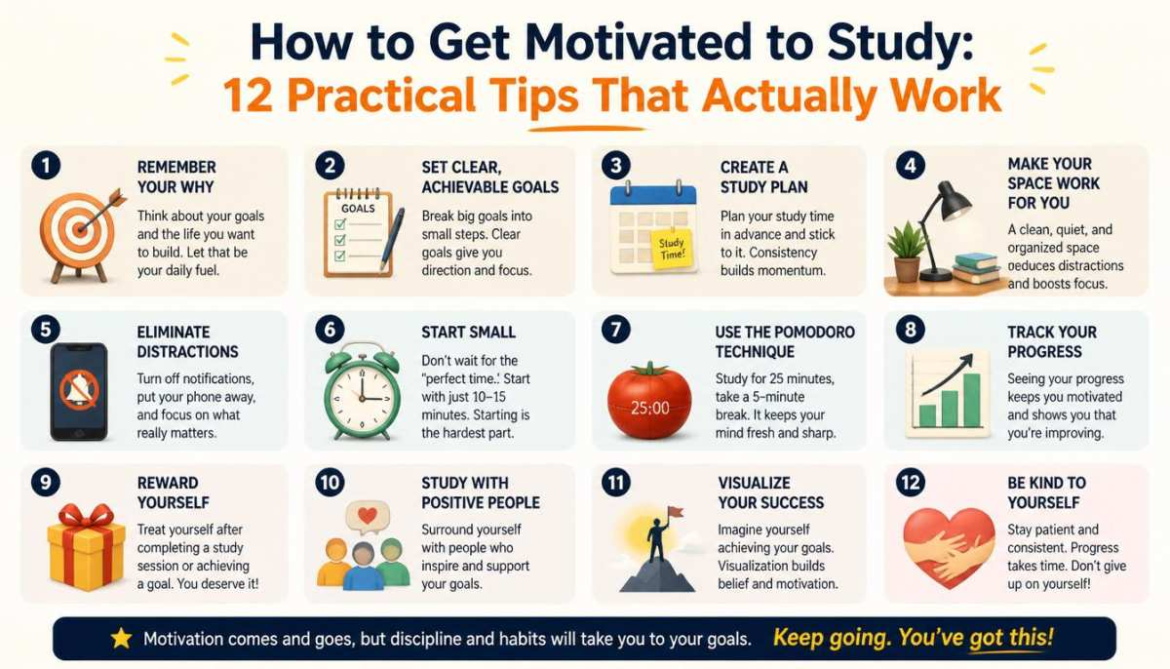
12 Practical Ways to Get Motivated to Study

1. Start With the Smallest Possible Task
The hardest part of any study session is the first five minutes. The brain resists starting because the task looks large. The solution is to make the starting point so small that it becomes impossible to say no to it.
Do not sit down and tell yourself you are going to study for two hours. Tell yourself you are going to read one page. Or write one paragraph. Or just open the textbook and read the first heading.
Once you begin, momentum builds naturally. The brain shifts from avoidance mode into focus mode, and continuing becomes easier than stopping. Almost every study session that starts with one small task ends up running well beyond it.
2. Know Your Why Before You Open a Book
Generic goals do not motivate anyone. Telling yourself you need to study to get good grades is not a reason, it is an instruction. You need a reason that connects to something you actually care about.
Think about what you want to achieve after completing this degree. What career do you want to build? What kind of life do you want to create? Most importantly, who do you want to become? Write your answer down and place it somewhere you’ll see every day. When motivation fades, that reminder can help you refocus and return to your studies with a clear sense of purpose.
The clearer and more personal your reason is, the more effectively it works as a motivator when nothing else is working.
3. Build a Study Environment That Removes Decisions
Your environment shapes your behavior more than willpower does. A clean, organized, distraction-free space makes it significantly easier to sit down and study. A cluttered, noisy space full of distractions makes it harder, no matter how motivated you feel.
Set up your study space the night before. Put everything you need within reach. Close unnecessary tabs on your laptop. Put your phone in another room or at least face-down on the other side of the desk. Make the environment say study before you even sit down.
The goal is to reduce the number of decisions you have to make when you start your session. Every decision costs mental energy. Removing them in advance protects the energy for actual studying.
4. Use the Two-Minute Rule to Break Procrastination
If a task is taking longer than two minutes to start, you are overthinking it. The two-minute rule is simple: commit to working on something for just two minutes. That is it. Two minutes and then you can stop if you want to.
You almost never stop after two minutes. The reason is that starting dissolves the resistance. The task that felt heavy before you started feels completely manageable once you are inside it.
Use this rule specifically on the days when you feel zero motivation. Do not plan a full study session. Just commit to two minutes.
5 Use Time Blocks Instead of Studying Until You’re Done
Telling yourself you will study until you finish a chapter is a recipe for avoidance. The brain does not like open-ended commitments with no visible end point.
Time blocks work better. Set a timer for 25 to 45 minutes. Study until the timer goes off. Then take a proper break of 5 to 10 minutes. Then repeat.
This method, often called the Pomodoro Technique, works because it makes the end point visible. You are not studying until you understand thermodynamics. You are studying for 25 minutes. That is a completely different mental commitment and it is one the brain accepts far more easily.
6. Remove Distractions Before You Start, Not During
Many students believe they can manage distractions while studying by checking their phone “just for a minute” or quickly scrolling through social media. In reality, these small interruptions often turn into much longer breaks and make it difficult to regain focus.
Instead of trying to resist distractions during your study session, eliminate them before you begin. Put your phone on silent and leave it in another room, sign out of social media, close any unnecessary browser tabs, and let the people around you know that you need uninterrupted study time. Creating a distraction-free environment makes it much easier to stay focused from start to finish.
Distractions do not just waste the time you spend on them. Research shows that after a distraction it can take up to 23 minutes for the brain to return to full focus. Every interruption costs far more than it looks like on the surface.
7. Track Small Wins Every Single Day
Progress is one of the most powerful motivators available to students, and most students never track it. They focus entirely on what is left to do and never acknowledge what they have already done.
At the end of every study session write down three things you completed. Three topics covered, three pages read, three problems solved. It does not matter how small they are. The act of writing them down creates a record of progress and signals to the brain that the effort was worthwhile.
Over time this record becomes proof that you are moving forward, and proof of progress is one of the most reliable ways to maintain motivation during long study periods.
8. Find One Person to Study With or Report To
Accountability changes behavior. When you know someone else is expecting you to show up or to have completed something, the chances of you actually doing it increase significantly.
This does not require a formal study group. It can be as simple as texting a classmate every evening to say what you studied that day. Or agreeing to sit in the library at the same time. Or asking a friend to check in with you once a week about your progress.
The social element of accountability works because it adds a layer of commitment beyond your own internal discipline. You are not just answering to yourself anymore, and that matters on the days when self-discipline alone is not enough.
9. Reward Yourself After Study Sessions, Not Before
Rewards work as study motivation, but only when they come after the work, not before. Watching one episode of a show before you study is not a reward. It is a delay tactic. Watching one episode after a solid study session is a genuine reward that reinforces the behavior.
Keep your rewards realistic and proportional. Finishing a 25-minute session earns a short break. Finishing a full day of studying earns something more significant. Finishing a difficult exam earns something you have been looking forward to for a while.
The brain learns to associate studying with positive outcomes, which makes starting easier over time.
10. Rotate Subjects to Prevent Mental Fatigue
Studying the same subject for hours without a break is one of the fastest ways to kill motivation. The brain habituates to repeated input and stops processing it effectively.
Switch subjects every one to two hours. If you have been working on mathematics, move to history or language for the next session. The change of subject acts as a reset for the brain and makes it easier to stay engaged across a long study day.
This approach also means that on difficult study days, no single subject carries the full weight of the session. Spreading the work across subjects makes the overall load feel more manageable.
11. Study During Your Highest Energy Hours
Everyone has natural peak performance periods during the day. Some people think most clearly in the early morning before other demands take over. Others hit their peak in the mid-morning or early afternoon. A smaller group functions best in the evening.
Identify when your brain is sharpest and protect that time for your most demanding study work. Save lower-energy tasks such as reviewing notes or organizing materials for your off-peak hours.
Studying during your peak hours makes the same amount of work feel significantly easier because your brain is operating at higher capacity. It also reduces the feeling of struggling to concentrate, which is a major contributor to study avoidance.
12. Stop Waiting to Feel Ready and Start Anyway
This is arguably the most valuable tip and the one many students struggle to follow.
The truth is, you’ll rarely feel completely ready to study. There will always seem to be a better time, a cleaner workspace, a more energetic mood, or a version of yourself that feels more prepared. If you wait until everything feels perfect, you’ll keep delaying the work.
Motivation doesn’t come first action does. Begin studying even if you don’t feel like it. Once you get started, your brain gradually shifts into focus, and the motivation to keep going often appears within the first few minutes.
Successful students, researchers, and academics don’t rely on inspiration to begin. They follow a schedule, sit down when it’s time to study, and start working. Consistent action creates momentum, and motivation naturally follows.
How to Get Motivated to Study a Boring Subject

Every student has at least one subject that feels genuinely uninteresting. The temptation is to avoid it until the last possible moment, which only makes it worse.
The most effective approach for boring subjects is to find a personal connection to the material. Ask yourself how this subject connects to something you actually care about. A student who dislikes economics but wants to start a business will find the subject more engaging when they frame it as directly relevant to their future rather than as an abstract requirement.
Break boring subjects into the smallest possible sessions. Fifteen minutes on a subject you find dull is far more productive than zero minutes. Do the boring subject first in your study session when your willpower is highest, then reward yourself with the subjects you find more interesting afterward.
How to Get Motivated to Study After Burnout

Burnout is different from ordinary demotivation. It is a state of genuine mental exhaustion that cannot be fixed by tips and techniques. If you are burned out, the first step is rest, not more studying.
Give yourself one or two days of genuine rest with no study guilt attached. Sleep properly. Eat properly. Spend time doing something that genuinely restores your energy. Trying to push through burnout makes it worse and extends the recovery time significantly.
When you return to studying after burnout, start with much shorter sessions than usual. Thirty minutes is enough. Gradually rebuild the habit over the course of a week rather than trying to immediately return to full capacity.
Quick Motivation Starters When You Have Five Minutes
When you are struggling to begin, try one of these starting points before your study session.
Read the goals you wrote down for this semester. Look at your progress tracker from the previous week. Send a message to your accountability partner. Tidy your desk for five minutes. Read the introduction of whatever chapter you are starting. Write down the single most important thing you want to accomplish in the next hour.
Any one of these takes less than five minutes and almost all of them create enough momentum to begin a proper study session.
FAQ: How to Get Motivated to Study
Why do I have no motivation to study even when I know I need to?
Lack of motivation to study usually comes from one of three causes. The task feels too overwhelming, your goals don’t feel meaningful enough, or you’re mentally exhausted from other responsibilities. Instead of forcing yourself to study, identify the real reason behind your lack of motivation. Once you know what’s causing the problem, you can choose the right solution, such as breaking work into smaller tasks, reconnecting with your goals, or getting proper rest.
How do I get motivated to study when I am tired?
When you’re tired, reduce the length of your study session instead of skipping it completely. Even a focused 20-minute session helps maintain your study habit. However, if you’re genuinely exhausted, prioritize rest. A refreshed brain learns faster, remembers information better, and completes work more efficiently than one that’s mentally drained.
Does listening to music help with study motivation?
Yes, it can but it depends on both the person and the type of task. Instrumental music, classical music, or ambient sounds may improve focus by reducing background distractions. Music with lyrics can interrupt reading, writing, and memorization because it competes for your brain’s language-processing resources. Try different study environments to discover what helps you concentrate best.
Final Thoughts
Getting motivated to study is not about finding a magic feeling that makes everything easy. It is about building the right conditions, systems, and habits that make starting easier and stopping harder.
The tips in this guide work because they address the real reasons motivation fails: tasks that feel too large, purposes that feel unclear, and environments that make distraction easier than focus. Apply them one at a time rather than all at once. Start with the smallest possible task, know your reason for studying, and stop waiting for motivation to arrive before you begin.
For more study guides, productivity strategies, and academic advice, explore the full study resources section at Next Gen Taleem.

Andrew Charley is a digital marketer and content writer at NextGen Taleem, focused on creating valuable and easy-to-understand educational content. He specializes in writing about online learning, student resources, and modern digital trends in education. His work aims to help students and learners find practical knowledge, improve skills, and stay updated in a fast-changing digital world.
